Permanent roofline and eave lighting in Albuquerque
The part of the job that decides whether this looks built-in or bolted-on. Albuquerque housing stock is specific (tile, parapets, portals, scalloped brick) and each one wants handling differently.
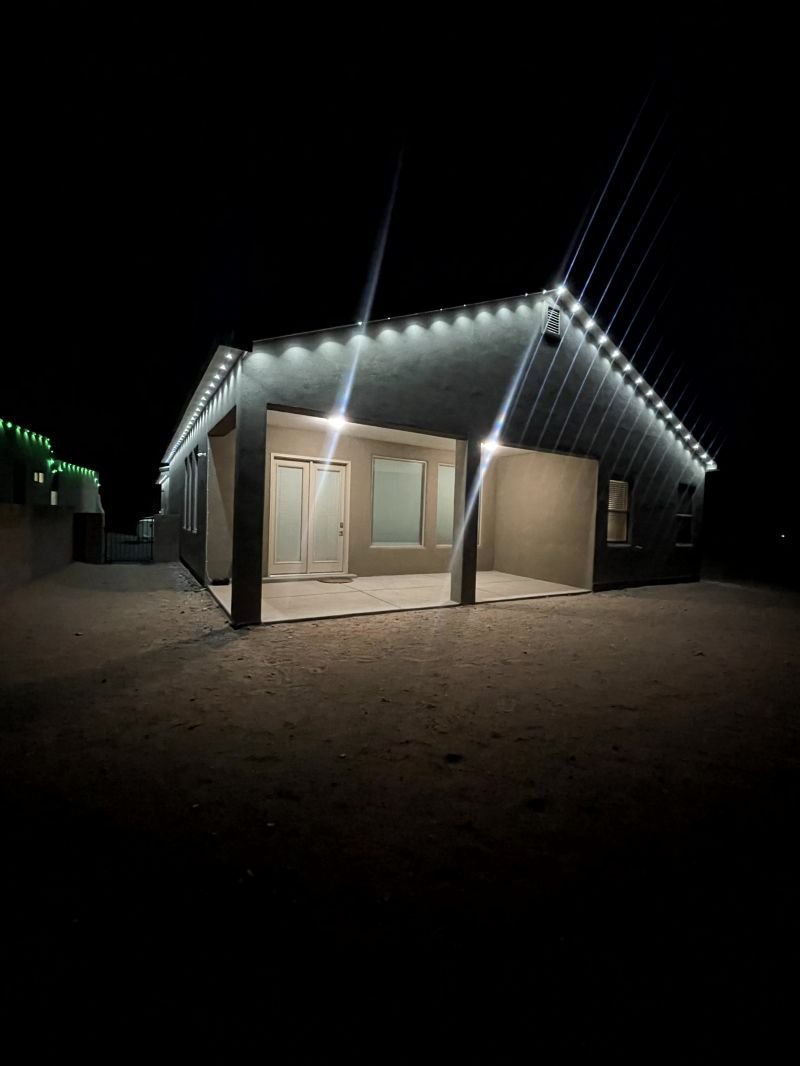
The five roof situations we meet in this city
Between the older valley houses, the 1970s Heights brick, the 1990s stucco tracts and the newer Rio Rancho and Ventana Ranch builds, almost every Albuquerque job is one of these.
-
Flat roof with a stucco parapet
The classic New Mexico elevation. The track mounts to the parapet edge or tucks just under the coping, and the light washes straight down a clean, uninterrupted plane of stucco. This is the version where people stop mid-sentence at the reveal. Straightforward to install, excellent result, and very forgiving of an irregular building shape.
-
Concrete or clay tile, pitched
Everywhere in the newer subdivisions. All the work happens off ladders at the fascia, because nobody should be walking the tile. It is slower and it costs more in labor, and that shows up honestly on your estimate rather than as a surprise. The result under a tile overhang is one of the better ones, because the overhang shades the track completely in daylight.
-
Territorial portal and stepped masses
A short run along the portal beam plus the main parapet line. Foot for foot, the portal is the highest-value lighting on the whole house: it lights the entry, it picks out the beam structure, and it is the bit people walk under. Stepped parapets give you a genuine architectural shape to trace instead of one long band.
-
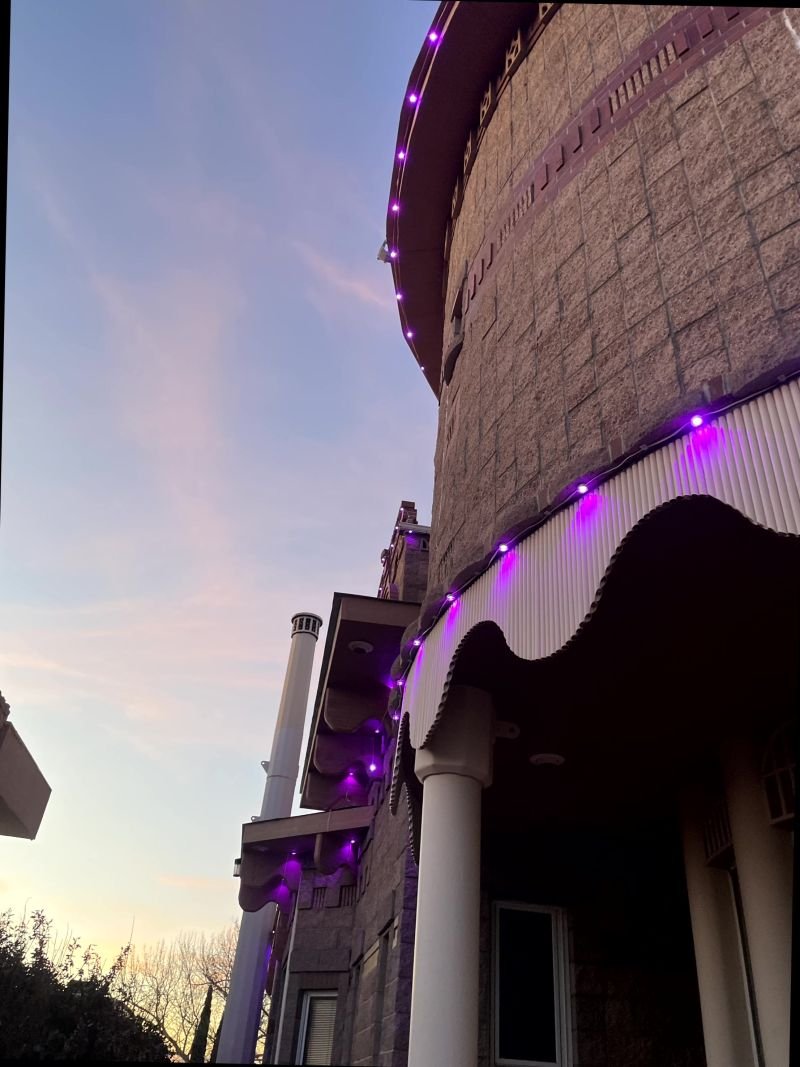
Brick with scalloped or profiled trim
Common through the established Heights streets. The track follows the trim profile rather than cutting across it, which takes longer and is the whole difference between looking considered and looking added-on. Worth the extra time every single time.
-
Two-story with gables and peaks
The most dramatic and the most expensive. More linear feet, more corners, higher and slower work. It is also where the design conversation matters most, because lighting every line on a complicated two-story elevation can end up busy. Often the best answer is the main roofline plus the two front peaks and nothing else. What that does to the price.
Why the mounting line is a design decision
There is usually more than one place the track could physically go, and they do not look the same. Under the fascia gives you the cleanest daylight result because the roof edge shades it completely. On the face of the fascia is sometimes the only option on a shallow overhang, and it wants a careful color match. Along a parapet coping gives the longest clean run and the broadest wash.
We walk this with you at the measure and, where it is a genuine judgment call, we will show you both and let you choose. It is your house and you are the one who looks at it every day.
What we check before we quote a roofline
- Fascia condition. Soft, split or previously patched fascia gets flagged before anything is fastened to it.
- Overhang depth. Determines how completely hidden the channel is in daylight, and therefore the mounting line.
- Existing penetrations. Old staples, nails and clip holes from years of seasonal installs. We work around and, where sensible, seal them.
- Gutter position. So the channel line and the gutter line do not fight each other.
- Power route. Where the low-voltage run gets back to the controller without crossing anything visible.
- Sight lines from the street. Where you will actually be standing when you look at it.
All of that is what makes the estimate take half an hour instead of five minutes, and it is why we do not quote from satellite imagery. More on the process in how it works, and on the hardware itself on the LED page.
Not sure what your roof is?
You do not need to know. Send the quote form with roughly what part of town you are in, and we will work it out when we are standing in front of it. Here is where we cover.
Mounting and roof questions
Will anyone be walking on my tile roof?
No. Concrete and clay tile cracks under foot, and the damage is often invisible on the day and expensive the next time it rains hard. We work off ladders at the fascia. If any lighting company is casual about walking your tile, that alone is a reason to get another quote.
What if my fascia is in bad shape?
We will tell you at the estimate rather than discovering it on install day. Rotten or soft fascia needs sorting before anything is fastened to it. You would be attaching a ten-year fixture to a board that is not going to last five. Sometimes that means a small repair first; occasionally it means a different mounting line.
Can it go on a flat roof with a parapet?
Yes, and it is one of the best-looking versions of this job. The track mounts to the parapet edge or just under the coping, and the wash runs down a flat stucco plane with nothing interrupting it. Given how much of Albuquerque is exactly this, it is a very common install for us.
What about gutters: does it interfere?
No. The channel sits above or alongside the gutter line depending on your trim, and it does not obstruct flow or make cleaning them harder. Plenty of our installs run directly along a gutter line and you would not know from the ground.
Can you follow a curved or scalloped trim?
Within reason, yes, and it usually looks excellent. The older Northeast Heights brick houses with scalloped fascia take it beautifully. Very tight radii are the limit. We will look at yours and tell you honestly whether it follows the curve or whether a straight run above it is the better result.
Does it damage the house if it is ever removed?
It is mechanically fastened into fascia, so there are fixings, sealed on install. If a future owner wants it gone it comes off, the holes are filled and the fascia is painted. It is the same order of intervention as removing a gutter.
Let us look at your actual roofline
Tell us about the house and we will come measure it. You get a real number for your actual roof, not a guess off a satellite photo.
- Backed by a 15-year warranty.
- Albuquerque metro only. We are not a franchise routing you to a subcontractor.
- Every estimate is measured on site, in person, before you get a number.
Start your quote
Two dropdowns and your name. Everything else is optional.